GLAS: Global Landslide Analytics System
AI-driven landslide risk assessment using geophysical and meteorological data. ISEF 1st Grand Prize, $10k. Published at 2021 MIT URTC.
Shrey Joshi*, Ishaan Javali*, Dr. Ellen Rathje
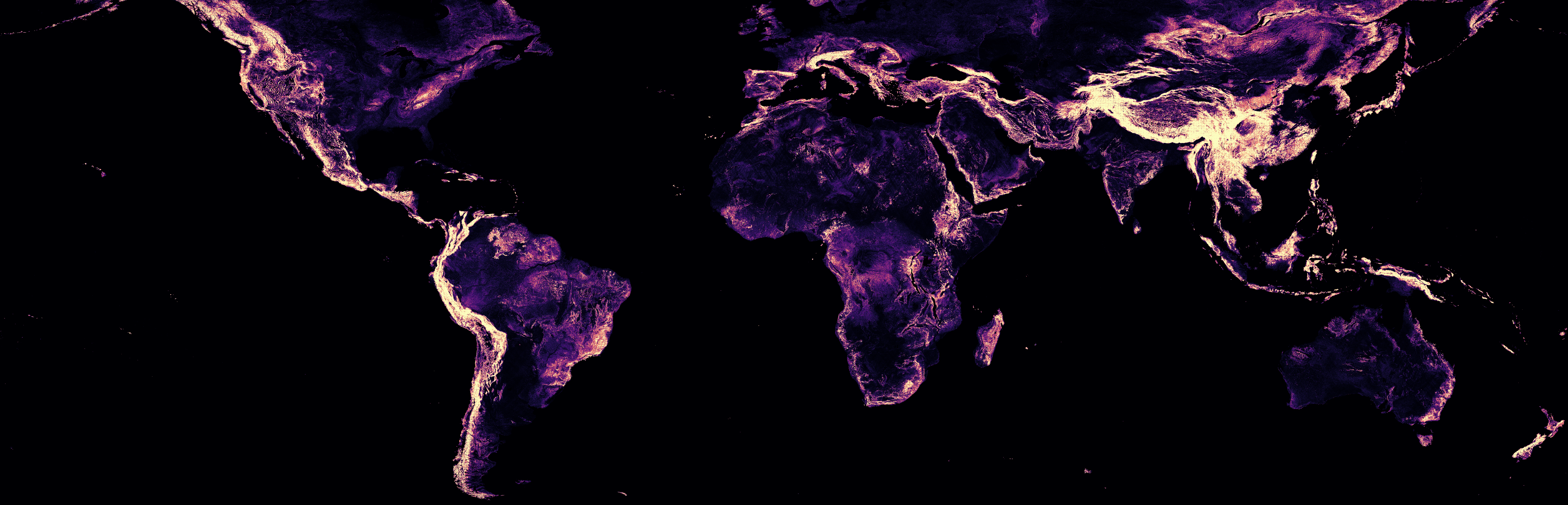
Code / Poster / IEEE Xplore / Landslide Risk Map
ISEF 1st Grand Prize, $10k won — Accepted & published to 2021 MIT URTC
We introduce GLAS: a scalable, low-latency, Global Landslide Analytics System, along with the first publicly available dataset of Global Landslide Incidents and Features (GLIF). GLIF consists of elevation, climate, lithology, forest change, and human infrastructure data for tens of thousands of landslide and non-landslide locations/times around the world. GLAS consists of Random Forest (RF) models trained on GLIF for three tasks: landslide forecasting (binary), landslide severity assessment (categorical), and landslide date estimation (categorical).
A new data-driven susceptibility mapping approach is derived using a weighted sum of static features and RF feature importances. We also demonstrate that historical multispectral LANDSAT-8 satellite data can be used to detect sudden changes in bare-earth exposure (Red Band: 655nm) and soil moisture (SWIR: Bands 5 & 7) to detect unreported rainfall-induced landslides, which could serve as additional training data by adding to GLIF’s repository of landslide instances.
